Showing posts with label saddle. Show all posts

Saturday, November 15, 2025

How do cyclists adjust their saddles to the correct height and fore or aft position?

The height, fore and aft adjustment for saddle is the same for all bicycles. You will find very clear instruction with photos from “Raleigh Bike Manuals & Quick Start Guide”.

From there, you can click on link to Raleigh bike Owners Manual. If the links I shared are broken, you can refer to the following question I answered earlier for other links and learn how to find your own bicycle owner's manual.

What are the best tips to maintain a bike in the proper way?

I extracted the following information from an older manual from Raleigh that I have:

“To adjust the saddle height, loosen the clamp bolt using an Allen key, spanner or the quick release lever and adjust the seat post to the required height. Adjust the height of the saddle so that when cycling along, your leg will be slightly bent with the pedal at its lowest point.

Important: When altering the height of the saddle, you must not pull the seat post out further than the limit mark (17). This must not be visible.”


Some clamps on seatposts are different but they are fitted to slide along the rails of the saddles in the same manner. These are the type of seat clamps that are often seen on alloy seatposts.


This is how the clamps with titanium bolts on a Prolite seatpost looks like.

This is how the saddle is attached to this lightweight seatpost from GUB. 


There are alloy and steel seatposts without clamps on them to attach to the saddles. Instead, the clamps are already attached under the saddles. As these clamps are heavier, you will not see them installed on road bikes. They are usually seen on saddles for cruisers or lower end bikes. For such, you loosen the nuts at both sides of the seat clamp to move the saddle forward or backward along the rails.

Cyclists of Canyon bikes, can even read about how they can adjust their saddle position and angle at the following link of their site. 

Bike Fitting for Road Bikes

If you prefer to see how the saddle height is adjusted, you can watch this video from Canyon Bikes.


The way the saddle from this Canyon Bike is attached to its seatpost is also different. You can see how the tilt is adjusted. 


Monday, January 1, 2018

How do I get the bike fit done on a cycle?

Sit on the saddle of the bicycle you are interested in buying. Place your hands on the handlebar. Do you feel that you are leaning way too forward? If it is and you still like the bike, you can request the bicycle shop to change a stem with a shorter reach or replace it with one which is adjustable so that you can raise the handlebar nearer to you.
As you sit on the saddle, are your feet sitting flat on the floor? Raise the seatpost up so that only the tips of your shoes are touching the floor. Sometimes, you may have to change the seatpost if you can’t push the seatpost down any lower as the bolts installed for the cage could be blocking the way. To resolve that, you can change seatpost to one that is shorter in length or have it cut shorter by the shop.
Now get off the saddle and straddle over the toptube. Is your crotch area touching it? If it is, ask the shop to let you try one with a smaller frame size. So, if a 16″ to 17″ frame size (M size) is too high for you, you may have to try a frame size of 15″ (S size). Anything above 18″ is L size. The size is usually printed on the frame where the seatpost is inserted, just below the toptube.
It is safer to buy the bicycle if your crotch area is about 2–3 inches away from the toptube as you straddle over it. That way, should you have an accident and fall, you will not be hurt by the toptube.

Friday, October 13, 2017

Are there bicycles suitable for overweight cylists?

I noticed that customers who are overweight tend to fear looking awkward on the regular bicycle with narrow tyres. They have a tendency to worry that the wheelset cannot withstand their weight and will break down on them while they are out cycling.
This anxiety can distract them from enjoying the ride and make them feel clumsy on their bikes. Moreover, most of them prefer larger saddles which will look awkward installed on a regular bike.
So, based on the questions asked, I tend to recommend that they get a fatbike.
A cyclist needs to pump his bicycle tubes around once every week or once every fortnight if he does not ride as often. However, for a very heavy rider, he may need to inflate his tubes more often as the tube need to be pumped to the maximum pressure stamped on the sidewall. It can look embarrassing for a larger rider to be cycling on a bicycle with tyres that look flat. So, this can a hassle.
Fatbike runs on 26x4″wheelset. The wider width tyres provides better balance for an overweight person. The air in the tubes is best pumped to the maximum pressure if it is ridden on paved road. You should let some air out if you are cycling it off road. Then the tyres will act like a suspension fork, making the rider feels like he is riding on a 2 wheeler monster truck. This eliminates the requirement to pump air in tubes more often for heavy riders.
Fatbike is not that common yet in Malaysia and this is a feedback from an overweight customer who took my advice to get a Fatbike. He said that it gives him a sense of pride. People are looking at the Fatbike and not him as an overweight rider. Strangers tend to approach him and asked him about his experience on his Fatbike. This encourages him to ride out more often which helps him to reduce some weight.

Friday, January 29, 2016

Cycling Tips for the Overweight

If you are overweight, exercise can help you to reduce your weight.  Make it easy on your joints by cycling.   


Do you have the right bike for your body weight and size?  If you are not sure, shop and ask around. Check with the shop if they know the maximum weight load of the bikes supplied.

Look at the specification of the bicycle to verify material used.

   
Most bicycles frames are made of high-tensile steel (hi ten steel) which is heavier or aluminum which is lighter. Chromoly frame bike are also available.  This material is lighter than hi ten steel but stronger.

Look at the specification of the wheels.  Look at the number of spokes holes.  It is common for bikes to have 28, 32 or 36 spokes wheel.  The Apollo unit shown here has 32 spokes holes with double wall rims.  The higher in number of spokes will help support the weight of a heavier rider.  That is why 40 or 48 spokes wheels are used on tandems meant for two riders.  Look at the way the spokes are laced onto the rim.  Spokes that are distributed evenly across the circumference of the rim are considered more durable.  The double walled rim will also help as it will significantly increase the strength of the wheel.

If you are not sure if you will take up cycling seriously or you lack confidence that the bicycle can take your weight load, consider buying a high-ten steel bike to start as it tend to be cheaper than an aluminum or chromoly frame bike. Moreover, most heavy duty bike are made of hi ten steel.  As hi ten steel will bend before it breaks, you will also get a prior warning if the bike has been overloaded.

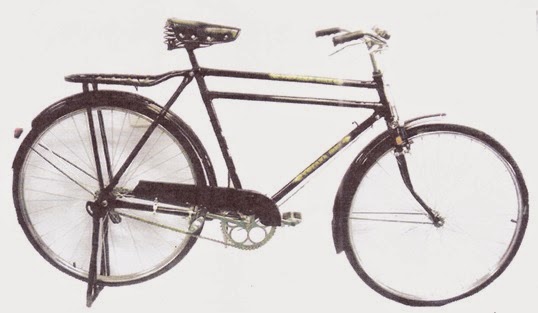
Check out bicycles like the old style double beam bike.  The additional top bar add strength to its capacity.  The upright handle bar which is curved closer to your body will allow you to sit more upright.  That will reduce the stress on your wrists as you no longer have to lean forward and put your weight on them as you ride.


As old style bikes are single speed, it would be best not to ride in areas that requires you to ride uphill as that can be hard on your knees.  It will be awkward if you have to get down from your bike to push it up.  Also, avoid cycling against the wind as you will have to exert more energy to ride which will shack you out before you could enjoy the ride.

Get your shades on before you start riding to avoid eye contact with fellow road users who could be checking you out which may make you feel self conscious.

Your butt is going to be sore when you just begin cycling.  Saddle soreness is to be expected even for cyclists without weight issues.  If you find it awkward to wear tight cyclist pants which come padded, consider wearing cargo pants with detachable padded undershot.


Tight cyclist pants can also be worn under your regular baggy pants.

An extra thick gel saddle cover will also help reduce the pain of a sore bottom after a long ride.

If it does not help, you will have to get yourself a wider saddle.

Unless your are cycling on a fat bike, avoid potholes whenever possible and if you hit one, lifting your butt off the saddle will reduce the pain and take the pressure off your back wheel.  So, saying, it would be best to invest in a pair of metal pedals as the plastic ones commonly supplied may not be able to hold up to your weight as you stand on them.

Alternatively, you can start by building up your stamina on a trainer.  With that you can mount your bicycle on it and practice cycling at home till you have the confidence to ride outdoor.


Meantime, you may also want to read, "The Escapades of an Overweight Cyclist" by Graham Butt, which hopefully, will give you the boost you need to start cycling yourself.


You can purchase similar product recommended in this article at Amazon.